
Independent site notice: HelpMyBenefits is not affiliated with Direct Express®, Comerica Bank, Bank of New York Mellon, Mastercard®, SSA, the U.S. Treasury, or any government agency. Learn more. For account-specific help, use the number on the back of your card.
If you have ever seen the terms “unbanked” or “underbanked” and wondered what they mean — or whether they apply to you — this page explains both definitions clearly, who is most affected, and what options are available to receive federal benefits without a traditional bank account.
What does unbanked mean?
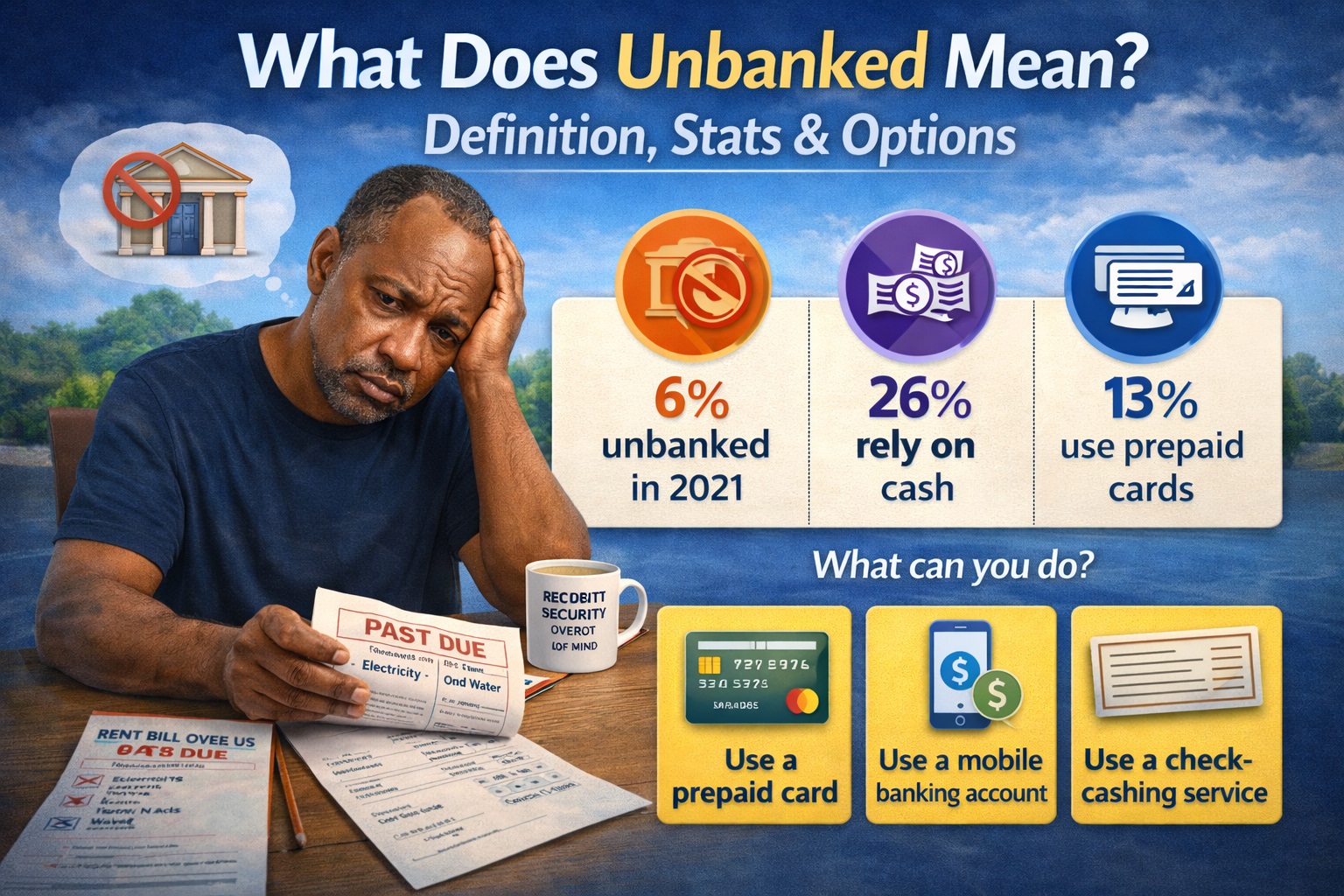
Unbanked means that no one in your household has a checking or savings account at a bank or credit union. You receive income, pay bills, and handle money entirely through cash, prepaid cards, or nonbank services — without a traditional bank account.
The term comes from the FDIC (Federal Deposit Insurance Corporation), which has tracked the unbanked population in the United States through a biennial survey since 2009. The most recent survey data, from 2023, found that approximately 4.2% of U.S. households — about 5.6 million households — were unbanked.
Many unbanked federal benefit recipients receive payments through the Direct Express card. If you are unsure whether you qualify for SSI or SSDI, the Social Security disability eligibility estimator can help you identify which program may apply to your situation.
What does underbanked mean?
Underbanked means that your household has a bank or credit union account, but you still rely on nonbank financial services for core needs — such as check cashing, money orders, payday loans, or pawn shop loans.
In other words, underbanked households have a bank account but do not use it as their primary financial tool. The 2023 FDIC survey found that 14.2% of U.S. households — about 19 million households — were underbanked.
Unbanked vs. underbanked vs. fully banked — at a glance
| Term | Definition | % of U.S. households (2023) |
|---|---|---|
| Unbanked | No bank or credit union account of any kind | 4.2% (~5.6M households) |
| Underbanked | Has a bank account but relies on nonbank services for core financial needs | 14.2% (~19M households) |
| Fully banked | Has a bank account and does not rely on nonbank financial services | 81.6% |
Source: 2023 FDIC National Survey of Unbanked and Underbanked Households, published November 2024.
Who is most likely to be unbanked?
The FDIC survey consistently finds that unbanked rates are significantly higher among certain groups. From the 2023 data:
- Lower-income households: Unbanked rates are much higher among households with lower incomes
- Less-educated households: Households without a high school diploma have higher unbanked rates
- Black households: 10.6% unbanked rate, vs. 1.9% for White households
- Hispanic households: 9.5% unbanked rate
- American Indian or Alaska Native households: 12.2% unbanked rate
- Working-age households with a disability: Higher unbanked rates than those without a disability
- Single-parent households: Higher unbanked rates than two-parent households
Unbanked rates among minority populations have fallen significantly — roughly by half since 2011 — but disparities remain.
Why do people remain unbanked?
The most commonly cited reasons for not having a bank account include:
- Not having enough money to meet minimum balance requirements
- Bank fees that feel unpredictable or too high (especially overdraft fees)
- Distrust of banks or financial institutions
- Privacy concerns
- A past banking problem — such as a closed account — that makes opening a new one difficult
- Not feeling that a bank account meets their needs
What options do unbanked people have for receiving federal benefits?
Federal law requires all Social Security, SSDI, and SSI payments to be made electronically. If you do not have a bank account, you have two main options:
Option 1: Direct Express debit card
The Direct Express card is a prepaid debit card issued specifically for federal benefit recipients who do not have a bank account. Your Social Security, SSI, or SSDI payment is deposited directly onto the card each month. You can use it to make purchases, withdraw cash at ATMs, and check your balance — without needing a bank account.
The card is free to enroll in and is one of the most common ways unbanked federal benefit recipients receive their payments. To sign up, call 1-800-333-1795.
→ What is the Direct Express card and how does it work?
Option 2: Open a bank or credit union account
Many banks and credit unions offer basic or “second chance” checking accounts designed for people who have had banking problems in the past. Some are specifically designed for low-income or unbanked customers. The FDIC’s BankFind tool can help you locate FDIC-insured institutions near you.
What nonbank services do unbanked people use?
Common nonbank financial services used by unbanked and underbanked households include:
- Prepaid cards — such as the Direct Express card or general-purpose reloadable cards
- Check cashing services — available at many retailers, including Walmart Money Center
- Money orders — for paying bills without a checking account
- Nonbank online payment services — such as PayPal, Venmo, or Cash App (about 50% of all households used these in 2023)
- Payday loans — short-term, high-interest loans, typically used as a credit alternative (generally not recommended due to high costs)
Is being unbanked the same as being poor?
No, though the two are related. While unbanked rates are higher among lower-income households, there are unbanked households at all income levels. The reasons for being unbanked are diverse — including distrust of financial institutions, past banking problems, and privacy concerns — not simply income level.
Conversely, many lower-income households are fully banked. The 2023 FDIC survey found that the vast majority of U.S. households across income levels have some form of bank account.
Frequently asked questions
What does unbanked mean?
Unbanked means that no one in your household has a checking or savings account at a bank or credit union. According to the FDIC’s 2023 survey, approximately 4.2% of U.S. households — about 5.6 million — were unbanked.
What does underbanked mean?
Underbanked means that your household has a bank or credit union account, but you also rely on nonbank financial services — such as check cashing, money orders, or payday loans — for core financial needs. The 2023 FDIC survey found that 14.2% of U.S. households, about 19 million, were underbanked.
How can I receive Social Security benefits without a bank account?
The Direct Express debit card is the main option for unbanked federal benefit recipients. It is a prepaid card issued by the program that deposits your monthly Social Security, SSI, or SSDI payment directly onto the card. It is free to enroll and does not require a bank account. Call 1-800-333-1795 to sign up.
How many people in the US are unbanked?
According to the FDIC’s most recent survey (2023), approximately 5.6 million U.S. households were unbanked — representing about 4.2% of all households. This is the lowest unbanked rate since the FDIC began tracking the data in 2009.
What is the difference between unbanked and underbanked?
Unbanked means having no bank account at all. Underbanked means having a bank account but still using nonbank services like check cashing or money orders for everyday financial needs. Both groups face limited access to mainstream financial services, but underbanked households have at least some connection to the banking system.
Related guides
- What is the Direct Express card? How it works for federal benefits
- How to get a Direct Express card: eligibility and sign-up
- Direct Express deposit dates 2026: full payment schedule
- How to check your Direct Express balance
- What is a Social Security representative payee?
- Approved for disability benefits? How SSI and SSDI back pay works