
Independent site notice: HelpMyBenefits is not affiliated with Direct Express®, Comerica Bank, Bank of New York Mellon, Mastercard®, SSA, the U.S. Treasury, or any government agency. Learn more. For account-specific help, use the number on the back of your card.
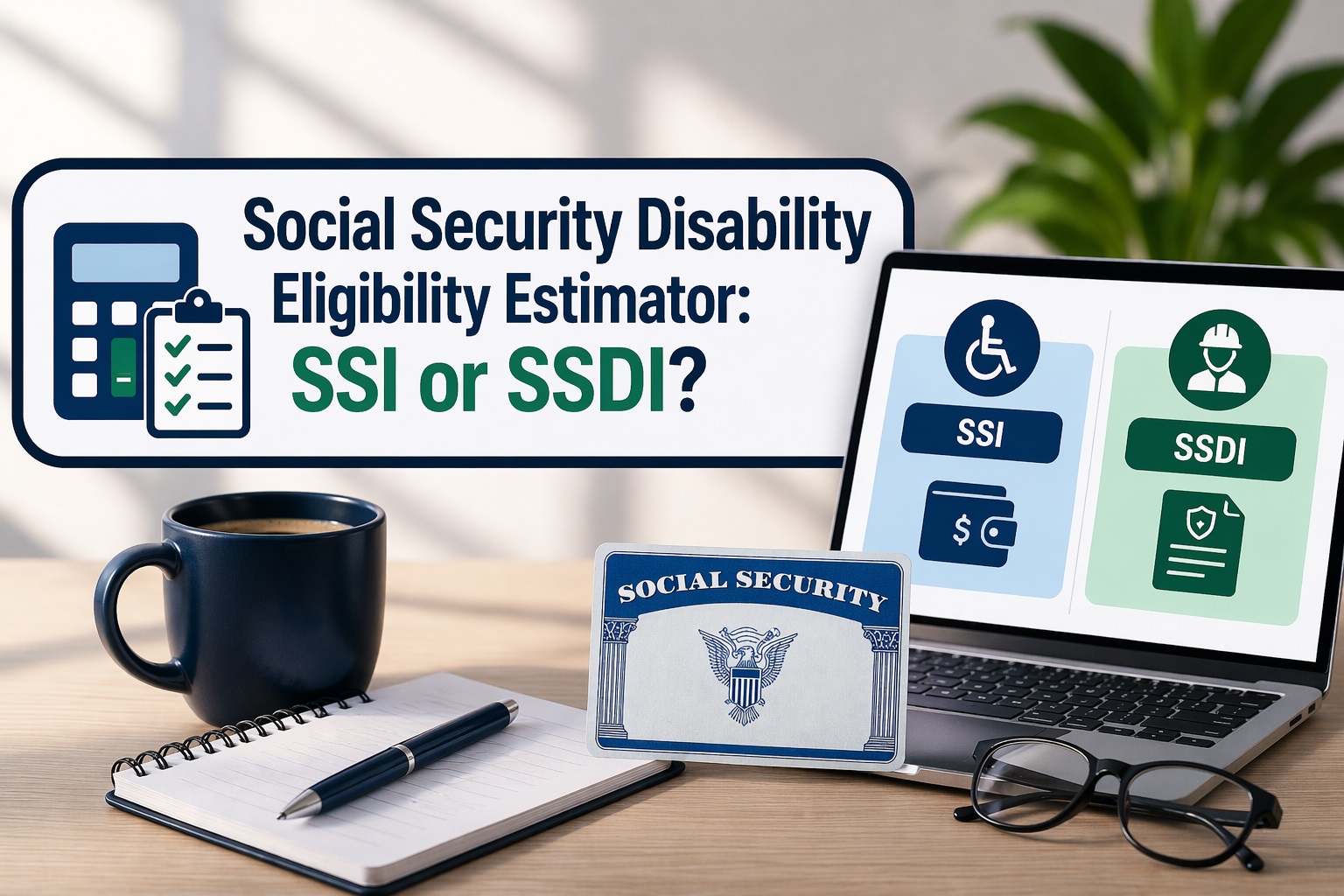
The estimator below asks five questions based on the official SSA eligibility criteria to help you understand whether SSI (Supplemental Security Income) or SSDI (Social Security Disability Insurance) may apply to your situation. It does not replace a formal SSA determination, but it gives you a clear starting point before applying.
What is the difference between SSI and SSDI?
SSI and SSDI are both administered by the Social Security Administration, but they serve different populations and use different eligibility rules. SSDI is an insurance program funded through payroll taxes. To qualify, you must have worked and paid Social Security taxes for a sufficient period — generally at least 5 of the last 10 years for most adults — and have a qualifying disability. SSI is a needs-based program with no work history requirement. It is available to people who are aged 65 or older, blind, or disabled and who have limited income and resources, regardless of work history.
Some people qualify for both programs simultaneously. This is called “concurrent benefits.” It typically happens when someone qualifies for SSDI based on work credits but their SSDI payment is low enough that SSI can supplement it up to the federal benefit rate.
SSI eligibility requirements in 2026
To qualify for SSI in 2026, you must meet all of the following conditions. You must be a U.S. citizen or qualifying non-citizen living in one of the 50 states, the District of Columbia, or the Northern Mariana Islands. You must be age 65 or older, blind, or have a disability expected to last at least 12 months or result in death. Your income must be limited — the SSA generally looks at whether your earnings exceed $2,073 per month from work, though the full income calculation includes other sources and exclusions. Your resources must not exceed $2,000 for an individual or $3,000 for a couple, though certain assets like your home and one vehicle are typically excluded.
The maximum federal SSI payment for 2026 is $994 per month for an individual and $1,491 per month for a couple. Some states add a supplement to the federal amount. The SSA determines your exact payment based on your countable income and living situation.
SSDI eligibility requirements in 2026
SSDI eligibility depends on two main factors: a qualifying disability and sufficient work credits. On the disability side, your condition must significantly limit your ability to do basic work activities for at least 12 consecutive months, or be expected to result in death. The SSA also uses the Substantial Gainful Activity (SGA) threshold to evaluate whether your work activity disqualifies you. In 2026, the SGA limit is $1,690 per month for non-blind individuals and $2,830 per month for those who are blind under SSA rules.
On the work credits side, you generally need 40 credits, with 20 earned in the last 10 years ending with the year your disability begins. In 2026, you earn one credit for each $1,890 in wages or self-employment income, up to four credits per year. Younger workers may qualify with fewer credits. If you are approved, the average SSDI payment in early 2026 is approximately $1,634 per month for disabled workers.
What the estimator does and does not do
The tool above uses the core SSA eligibility criteria to point you toward the program most likely to apply to your situation. It covers citizenship and residency, age or disability status, income and resource limits for SSI, work history for SSDI, and the 2026 SGA earnings threshold. It does not evaluate your medical records, calculate your exact benefit amount, or access any SSA system. The SSA makes the final determination based on your complete application.
If the estimator suggests you may qualify, the next step is to apply formally. You can start an application online at ssa.gov/applyfordisability or call the SSA at 1-800-772-1213.
Common reasons applications are denied
The SSA denies a significant portion of initial disability applications, most often because the medical evidence does not clearly establish that the condition prevents substantial work, because the applicant is still earning above the SGA threshold, or because the work history is insufficient for SSDI. For SSI, denials often result from income or resources exceeding the program limits, or from missing documentation.
A denial on the first application does not end the process. The SSA has an appeals process that includes reconsideration, a hearing before an administrative law judge, and further review. Many applicants who are initially denied are approved at the hearing stage.
Frequently asked questions
Can I apply for both SSI and SSDI at the same time?
Yes. The SSA allows you to apply for both programs simultaneously. If you qualify for both, you may receive concurrent benefits, where SSDI provides the primary payment and SSI supplements it if the SSDI amount is below the federal benefit rate.
Does the estimator store any of my answers?
No. All answers are processed in your browser and nothing is stored or transmitted.
What if I am not yet 65 but have a disability?
Age 65 is the threshold for qualifying based on age alone under SSI. If you are younger and have a qualifying disability, you may still be eligible for SSI or SSDI based on that disability. The estimator accounts for this in the second question.
How long does it take to get approved?
The SSA does not publish a fixed timeline. Initial decisions typically take several months. If a hearing is required, the process can take significantly longer. The SSA website provides current processing time estimates at ssa.gov.
If you receive benefits on a Direct Express card, you can track your deposit dates and manage your card using the guides available throughout this site. The Direct Express deposit dates guide and the SSI and SSDI back pay guide cover the most common questions once benefits begin.