

Independent site notice: HelpMyBenefits is not affiliated with Direct Express®, Comerica Bank, Bank of New York Mellon, Mastercard®, SSA, the U.S. Treasury, or any government agency. Learn more. For account-specific help, use the number on the back of your card.
If you were recently approved for SSI or SSDI, you may be entitled to back pay — a lump sum covering the months you were waiting for approval. This guide explains how back pay is calculated for each program, when it arrives, how it is paid, and how to track it if it has not shown up yet.
If you have not yet applied and are unsure which program applies to you, use the SSI and SSDI eligibility estimator to check your situation first.
What is SSI/SSDI back pay?
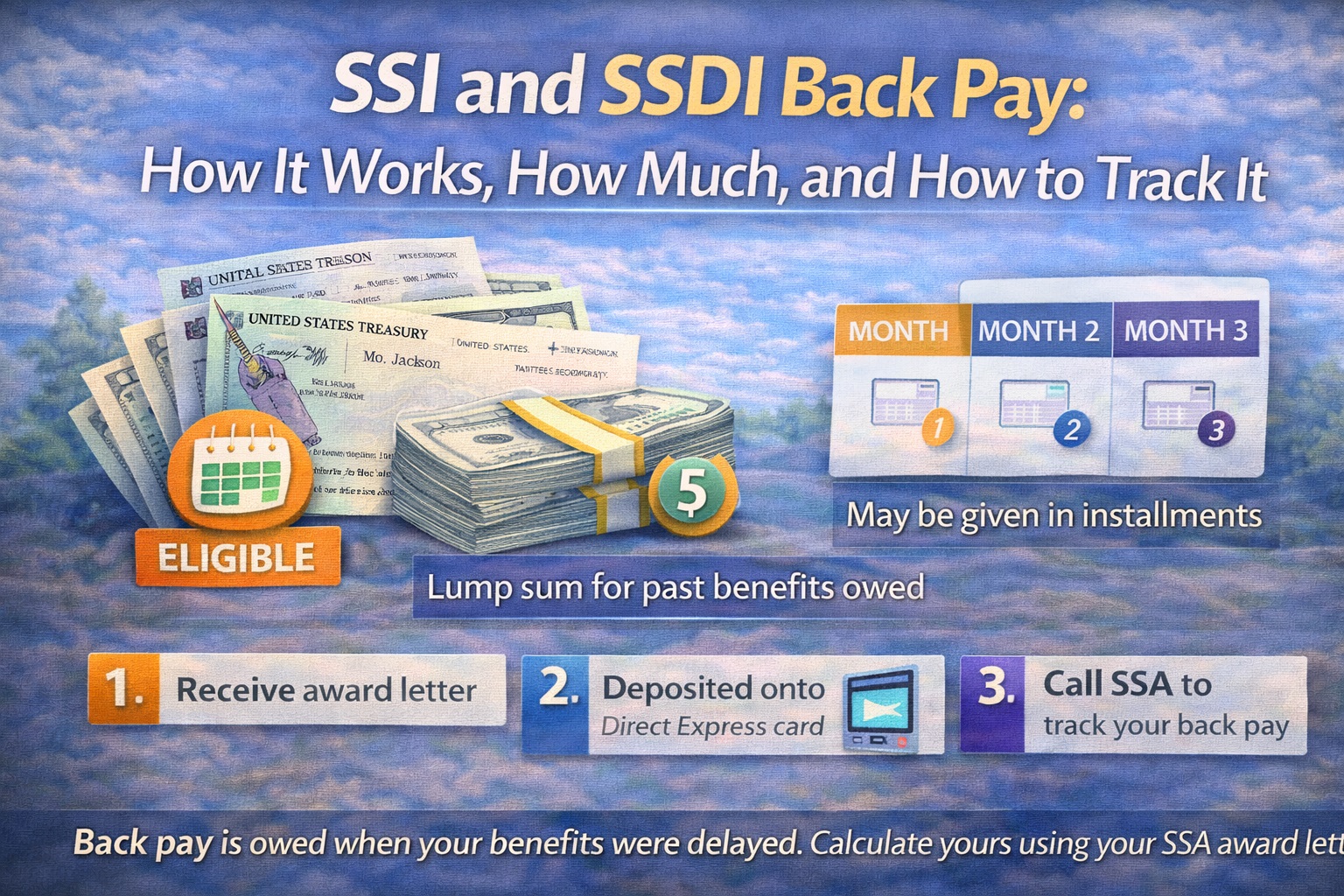
Back pay is a lump-sum payment covering the months between when you became eligible for benefits and when you actually started receiving them. Disability applications can take months or years to process, so back pay compensates you for that gap.
The rules differ significantly between SSDI and SSI — so it matters which program you are receiving.
SSDI back pay: how it is calculated
SSDI (Social Security Disability Insurance) has two types of back payments:
1. Standard back pay (waiting period gap)
This covers the gap between your application date and when your benefits were approved. SSDI has a mandatory 5-month waiting period after your disability onset date — you cannot receive benefits for those first 5 months no matter what.
How to calculate your SSDI back pay:
- Count the months from your disability onset date to your approval date
- Subtract 5 months (the mandatory waiting period)
- The result is the number of months of back pay you are entitled to, up to a maximum of 12 months
- Multiply by your monthly SSDI benefit amount
Example: Disability onset January 2025. Approved January 2026. That is 12 months minus the 5-month waiting period = 7 months of back pay. At an average 2026 SSDI payment of approximately $1,630/month, that would be roughly $11,410 in back pay.
2. Retroactive benefits (pre-application period)
If you became disabled before you applied, SSDI can also pay retroactive benefits going back up to 12 months before your application date — provided your disability onset predates the application. SSI does not offer retroactive benefits.
SSI back pay: how it is calculated
SSI (Supplemental Security Income) is simpler. SSI does not offer retroactive benefits — back pay only covers the gap between your application date and your approval date. There is no waiting period like SSDI.
How to calculate your SSI back pay:
- Count the full months between your application date and your first payment date
- Multiply by the SSI federal benefit rate for each month ($994/month for individuals in 2026)
- Subtract any income that would have reduced your SSI during those months
Important: Because SSI has no retroactivity, applying as soon as you become disabled is critical — you permanently lose any months before your application date.
SSI back pay installment rules
Large SSI back pay amounts are paid in installments, not all at once — to protect your SSI eligibility. The SSI resource limit is $2,000 for individuals. Receiving a large lump sum could push your resources over the limit and temporarily suspend your SSI benefits.
If your SSI back pay exceeds three times the maximum monthly SSI benefit (3 × $994 = $2,982 in 2026), the SSA will pay it in installments:
- First installment: Up to 3× the monthly SSI federal benefit rate
- Second installment: Six months after the first, same cap
- Third installment: Any remaining balance, six months after the second
SSDI back pay is generally paid as a single lump sum and is not subject to the SSI installment rule — unless you receive both SSDI and SSI simultaneously.
When does back pay arrive?
- SSDI: Back pay typically arrives as a lump sum approximately 60 days after approval. Some recipients see it within a few weeks; the SSA says it can take 3–5 months in some cases.
- SSI: Back pay generally arrives with or shortly after your first monthly payment, also approximately 60 days after approval.
To estimate how much back pay you may be owed based on your specific dates and benefit amount, use the SSI and SSDI back pay calculator.
How is back pay paid — Direct Express or bank account?
Back pay is delivered the same way your regular monthly benefits are paid:
- If you have direct deposit to a bank account, the back pay is deposited there
- If you receive benefits on a Direct Express card, the back pay is loaded directly onto your card
You do not need to request back pay — the SSA processes it automatically after approval.
→ Learn about the Direct Express card for federal benefits
How to track your disability back pay
If your back pay has not arrived after 60 days from approval, here is how to check its status:
- Log in to your my Social Security account at ssa.gov/myaccount and review your payment history. Approved back pay payments will appear there once processed.
- Call the SSA directly at 1-800-772-1213 (TTY: 1-800-325-0778), Monday–Friday, 8 a.m.–7 p.m. Ask specifically about the status of your back pay award.
- Contact your attorney or representative if one assisted with your claim — they receive their fee (typically 25% of back pay, capped at $7,200) directly from the SSA before the remainder is sent to you, so they may have information about processing status.
SSI resource limit and back pay: protect your benefits
Important for SSI recipients: If you receive SSI, the $2,000 resource limit applies to money in your accounts. A large back pay deposit could push you over the limit, potentially suspending your ongoing SSI benefits if you do not spend down the excess within the SSA’s allowed period.
Options to protect your SSI eligibility after receiving back pay:
- ABLE accounts: You can deposit up to $20,000 per year in an ABLE account (for eligible individuals with disabilities) — funds in ABLE accounts do not count toward SSI’s resource limit
- Spend on exempt resources: Housing (if you own a home), a vehicle for transportation, and household goods generally do not count toward the SSI resource limit
- Plan promptly: Contact the SSA or a benefits counselor to understand your specific situation before receiving a large back pay amount
What can you spend SSI back pay on?
SSI back pay can be spent on anything the beneficiary needs — housing, food, medical care, clothing, transportation, household items. However, for child SSI recipients, the SSA requires that back pay be held in a dedicated account and spent on the child’s needs, not commingled with the representative payee’s personal funds.
Frequently asked questions
How does SSDI and SSI back pay work?
Back pay covers the months between when you were eligible for benefits and when you actually started receiving them. SSDI back pay subtracts a mandatory 5-month waiting period and can go retroactive up to 12 months before your application. SSI back pay starts from the month after you applied — no retroactivity. Both are paid as a lump sum (or in installments for large SSI amounts) approximately 60 days after approval.
How do I track my disability back pay?
Log in to your my Social Security account at ssa.gov/myaccount and check your payment history. You can also call the SSA at 1-800-772-1213 and ask specifically about the status of your back pay award. If an attorney represented you, contact them — the SSA deducts the attorney fee from the back pay before sending the remainder.
Will SSDI or SSI back pay come on my Direct Express card?
Yes. If your regular benefits are paid to a Direct Express card, your back pay will also be loaded onto the same card automatically after approval. You do not need to request it separately.
What can I spend my child’s SSI back pay on?
SSI back pay for a child must be spent on the child’s needs — housing, food, medical care, clothing, education, and similar expenses. As a representative payee, you cannot use the child’s back pay for your own expenses. Keep records of how the funds are spent, as the SSA requires an annual accounting from representative payees.
SSI back pay released to direct deposit — what should I expect?
SSI back pay is released to your direct deposit account or Direct Express card approximately 60 days after your claim is approved. For large amounts (over 3× the monthly SSI rate), it will arrive in installments spaced 6 months apart. The first check your receive should include your first month’s regular benefit plus the initial back pay installment.