

Independent site notice: HelpMyBenefits is not affiliated with Direct Express®, Comerica Bank, Bank of New York Mellon, Mastercard®, SSA, the U.S. Treasury, or any government agency. Learn more. For account-specific help, use the number on the back of your card.
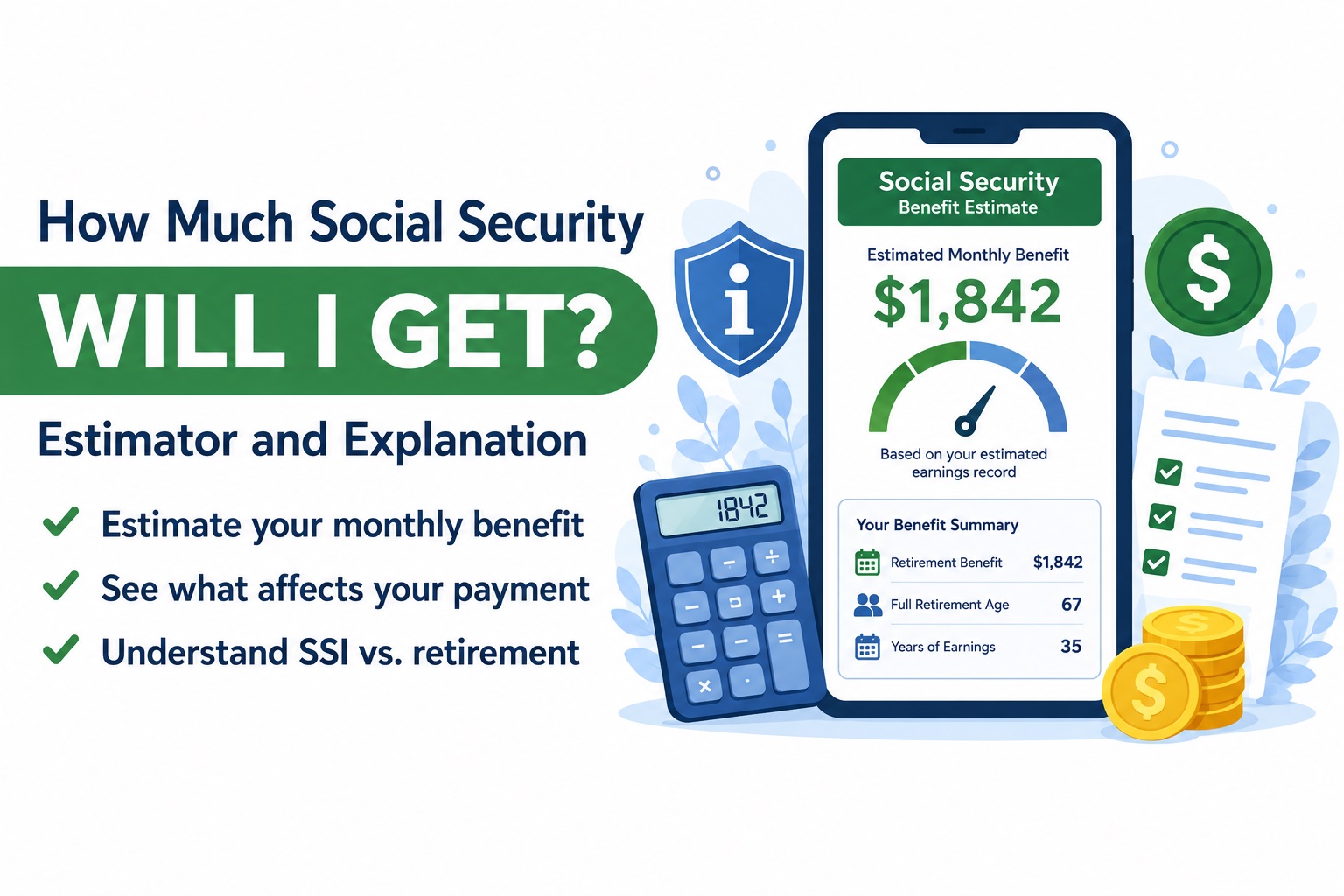
Your Social Security retirement benefit is based on how much you earned during your working years and the age at which you claim. This page explains how the calculation works and includes an estimator to give you a ballpark figure.
Social Security benefit estimator
Use your average yearly income over your working career, not just recent years.
How Social Security calculates your benefit
The SSA uses a three-step formula to determine your monthly benefit amount. Understanding each step helps you make better decisions about when to claim.
Step 1: Your earnings record (AIME)
The SSA looks at your earnings for every year you worked, adjusts them for wage inflation, takes your highest 35 years, and calculates a monthly average called your Average Indexed Monthly Earnings (AIME). If you worked fewer than 35 years, the missing years count as zero — which lowers your average.
Step 2: The benefit formula (PIA)
The SSA applies a progressive formula to your AIME to calculate your Primary Insurance Amount (PIA) — what you would receive if you claimed at exactly your full retirement age. The formula gives a higher percentage to lower earners, which is why Social Security replaces a larger share of income for lower-wage workers.
Step 3: Claiming age adjustment
Your PIA is then adjusted up or down depending on when you claim relative to your full retirement age (FRA). For most people born in 1960 or later, FRA is 67.
| Claiming age | Effect on benefit |
|---|---|
| 62 (earliest possible) | Up to 30% permanent reduction |
| 63–66 | Graduated reduction |
| 67 (full retirement age) | 100% of your PIA — no adjustment |
| 68–69 | 8% increase per year of delay |
| 70 (maximum) | 24% above your FRA benefit |
What is the average Social Security benefit in 2026?
As of 2026, the average monthly Social Security retirement benefit is approximately $1,980 per month. The maximum possible benefit for someone claiming at age 70 with a high earnings history is around $5,108 per month. The minimum benefit for someone with a full career at low wages is substantially lower.
These numbers change each year with cost-of-living adjustments (COLA).
What reduces your Social Security benefit
- Claiming before your full retirement age — the earlier you claim, the more your benefit is permanently reduced
- Fewer than 35 working years — zero-income years pull down your AIME
- Lower lifetime earnings — the benefit formula is progressive but tied to your actual wage history
- Working while collecting before FRA — if you earn above the annual limit, the SSA temporarily withholds part of your benefit (it is added back later, but it reduces your short-term income)
- Medicare premiums — Part B premiums are typically deducted directly from your Social Security payment
What increases your Social Security benefit
- Delaying your claim past FRA — each year you wait past 67 (up to 70) adds 8% permanently
- A full 35-year earnings history — replacing zero years with real earnings improves your AIME
- Higher lifetime wages — up to the annual taxable maximum each year
- Cost-of-living adjustments (COLA) — the SSA adjusts benefits annually for inflation
- Spousal or survivor benefits — in some cases you may qualify for a higher benefit based on a spouse’s record
How to get your official Social Security estimate
The most accurate way to know your actual expected benefit is through the SSA directly:
- Go to ssa.gov/myaccount and create or log in to your my Social Security account.
- Under “Your Benefits,” select “Retirement” to see personalized estimates at ages 62, 67, and 70 based on your actual earnings record.
- You can also view your full earnings history to check for any gaps or errors — correcting errors can increase your benefit.
Creating a my Social Security account is free and takes about 10 minutes. It is the only way to see estimates based on your actual earnings history rather than an approximation.
Frequently asked questions
How much Social Security will I get if I make $50,000 a year?
With an average annual income of $50,000 over your career, your estimated monthly benefit at full retirement age (67) would be approximately $1,600–$1,800 per month, depending on your exact earnings history. Claiming at 62 would reduce that by up to 30%; waiting until 70 would increase it by 24%. Use the calculator above for a more specific estimate based on your situation.
How much Social Security will I get at 62?
Claiming at 62 permanently reduces your benefit by up to 30% compared to your full retirement age amount. For someone with an average career income of $50,000, that typically means a monthly benefit in the range of $1,100–$1,300. The exact reduction depends on your birth year and your full retirement age.
What is the maximum Social Security benefit in 2026?
The maximum monthly Social Security retirement benefit in 2026 for someone claiming at age 70 is approximately $5,108. To receive the maximum, you would need to have earned at or above the Social Security taxable maximum for at least 35 years and delayed claiming until age 70.
How many years do you need to work to get Social Security?
You need at least 40 work credits to qualify for Social Security retirement benefits, which typically means at least 10 years of work. However, the SSA uses your highest 35 years of earnings to calculate your benefit — working fewer than 35 years means zero-income years are factored in, which reduces your monthly amount.
Does Social Security go up every year?
Yes. The SSA adjusts Social Security benefits each year through a cost-of-living adjustment (COLA) based on inflation. In recent years, COLA increases have ranged from under 2% to over 8%, depending on the Consumer Price Index for Urban Wage Earners (CPI-W).
Can I collect Social Security and still work?
Yes, but if you claim before your full retirement age and continue working, the SSA may temporarily withhold part of your benefit if your earnings exceed the annual earnings limit. Once you reach full retirement age, there is no earnings limit — you can work and receive your full Social Security benefit simultaneously.
Related guides
- Social Security payment date calculator
- Social Security disability eligibility estimator (SSI/SSDI)
- SSI and SSDI back pay: how it works
- SSI and SSDI back pay calculator
- Social Security award letter: how to get yours
- Why is my Social Security check late?
- What is a Social Security representative payee?
Last updated: May 2026